Changing wind patterns
Low wind speeds can contribute to a deterioration in air quality and promote the formation of fog. Additionally, wind turbines generate less energy under conditions of low wind. Conversely, high wind speeds can create hazardous conditions, including the risk of falling trees or storm surges. Storm surges in the Netherlands can develop when a prolonged strong north-western wind blows over the North Sea.
It is important to note that wind speeds are not constant, particularly during strong winds. During gusts, which typically last only a few seconds, wind speeds can exceed twice the hourly average. Moreover, intense rainfall can give rise to localised gusts and downbursts. These phenomena are expected to continue in the future. Observations indicate that wind speeds over land in the Netherlands have slightly decreased since around 1990, whereas no such trend is evident over the North Sea. This decline over land is likely attributable to an increase in surface roughness due to urbanisation.

Dangerous Winds
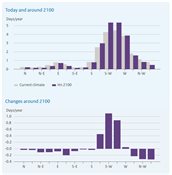
The primary hazard associated with strong winds is their potential to generate storm surges. The duration and direction of the wind are also critical factors. For the Netherlands, stormy north-western winds pose the greatest risk. The projected number of days with north-western winds reaching an average speed of at least 14 metres per second (equivalent to Beaufort force 7 or higher) has shown a slight decrease.
However, no significant change is anticipated in the wind speeds themselves. Consequently, future storms are not expected to elevate water levels above the average sea level more than at present, although the mean sea level is expected to rise, which will influence overall flood risk.