Trends & projections for saline intrusion
Saline intrusion in the Netherlands has evolved over centuries (PDF), shaped by both natural coastal dynamics and human activities. Since the end of the last ice age, rising sea levels have caused saltwater to infiltrate into the coastal provinces. This process is still evident in areas like the Wadden Sea, where tidal systems continue to facilitate seawater infiltration. As a result, shallow groundwater in these regions often remains salty.
From the Middle Ages onwards, the Dutch engaged in large-scale land reclamation and peatland excavation, altering the natural landscape. These actions have created a complex interaction (PDF) between salt and freshwater systems. The long-term effects of these changes are still unfolding and are expected to worsen saline intrusion.
Future saline intrusion
Future saline intrusion into groundwater is driven by three main processes: autonomous processes, land subsidence, and sea level rise. In some regions of the Netherlands, these processes occur simultaneously, reinforcing the effects.
Sea level rise
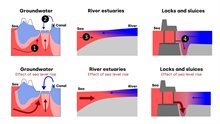
Salinisation is strongly associated (PDF) with sea level rise: As sea level rises, more saltwater enters the freshwater systems via estuaries, locks and groundwater. The extent of saline intrusion is therefore strongly influenced by the expected rise in sea level, as illustrated in the diagram below. The diagram shows that for each type of saline intrusion, sea level rise adds a bigger pressure, indicated by the heavier arrows.
The added weight of a higher sea level pushes up more saline groundwater in the left diagram below. In estuaries, future saline intrusion is also heavily influenced by sea level rise. Due to the rising sea levels, the saline water structurally reaches further into the river (see the middle diagram below). As a result of sea level rise, more saline water will enter with each lockage, as reflected in the right diagram below.
Autonomous processes
Autonomous processes refer to delayed responses of the fresh–saline groundwater system to historical interventions, often described as time-lag effects. For example, brackish groundwater continues to flow into deep polders as a result of past land reclamation. Similarly, peat extraction and drainage have altered groundwater gradients, triggering ongoing autonomous saline intrusion in deep polder landscapes that persists long after the original activities ceased.
Subsidence
Depending on the location within the Netherlands, future soil subsidence may either increase or decrease salinisation. Subsidence alters groundwater gradients, causing shifts in groundwater flow patterns. These changes can result in the transport of greater or smaller amounts of saline groundwater. For more detailed information, please refer to the page on subsidence.