Subsidence
Land subsidence is one of the most structural physical climate risks in the Netherlands. It refers to the sinking of the ground surface relative to a reference level, which may be caused by both natural and anthropogenic processes. Unlike acute risks such as floods, land subsidence develops gradually but has cumulative and often irreversible effects on the physical living environment. To gain insight into these effects it is essential to understand their nature, spatial distribution, and interaction with climate.
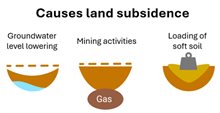
In the Netherlands, land subsidence occurs primarily due to:
- Human- and climate-induced groundwater level lowering (in peat and clay areas)
- Mining activities (such as the extraction of natural gas and salt)
- Loading of soft soil
Land subsidence due to groundwater level lowering and loading of the soft soil is most prominent in the provinces of Zeeland, South Holland, North Holland, Flevoland, Friesland, Groningen, and parts of Utrecht, Overijssel, and Drenthe. In these areas, the rate of subsidence can reach several millimetres per year. Subsidence due to mining activities occurs in the north(east) of the Netherlands. In South Limburg, decades of subsidence by mining activities have now reversed into a gradual uplift, sharply bounded by fault lines and former mining concessions, damaging the built environment where displacements are differential. This illustrates that vertical land motion encompasses both subsidence and uplift.
Groundwater level lowering
In the Netherlands, groundwater levels are artificially kept low in areas containing peat and clay soils to make these naturally wet soils suitable for agriculture and housing. Groundwater level lowering initiates or accelerates several processes leading to subsidence: shrinkage of the topsoil, consolidation and creep of the deeper (saturated) subsurface, and decomposition of organic matter (peat) in the aerated topsoil.
Shrinkage is the densification of soil, primarily clay, following drying of the unsaturated (top)soil. Consolidation is the compaction of saturated soil like peat and clay. How long this takes depends on the rate at which overpressured pore water is expelled from the soil. This overpressure results from increased stress in the soil, which can come from two sources: additional loading of the ground surface, or groundwater level lowering itself. In the latter case, the weight of the topsoil is no longer carried by the pore water, but instead it shifts onto the deeper subsurface. Creep, meanwhile, is time-dependent compaction representing the viscous behaviour of soft soil, which also occurs under constant loading conditions. Finally, decomposition occurs because lower groundwater levels allow oxygen to penetrate deeper into the soil. Under the influence of oxygen, decomposition of organic matter by microorganisms and fungi is accelerated. This weakens the soil structure, making it more vulnerable to mechanical processes, and releases carbon dioxide into the atmosphere (PDF). Eventually, this causes the soil to subside.
Loading of soft soils
Substantial consolidation and creep of soft soils (peat and clay) are often the result of loading, such as raising these areas with sand or artificial fill. Application of artificial fill is necessary to make the soil suitable for construction developments, such as buildings or infrastructure, and/or to compensate for past subsidence. However, because clay and peat have limited bearing capacity, the soil underneath the fill compresses through consolidation and creep. In many existing built-up areas on soft soil, ongoing subsidence will regularly require raising the infrastructure to the original construction level. As a result, land subsidence will accelerate, requiring further raising of the land surface.
Mining activities
Extraction of gas and salt takes place in the north(east) of the Netherlands and results in regional scale subsidence. Gas and salt are extracted from greater depths, often resulting in relatively large but shallow subsidence bowls of several kilometres in diameter. Due to their gradual shape, these subsidence bowls are unlikely to cause building damage directly, but they can create problems for water management once subsidence exceeds a certain level. The extraction of gas in the northern provinces of the Netherlands has caused induced earthquakes. Please note that human-induced seismic events are considered out of scope for the Dutch Climate Risk Portal.
Impact of land subsidence
On a national scale, land subsidence leads to structural economic burdens due to a reduced usability of land, increasing adaptation and mitigation costs. The physical impact of land subsidence is broad and affects many sectors, including the built environment, infrastructure, agriculture, nature, and water management.
Built environment
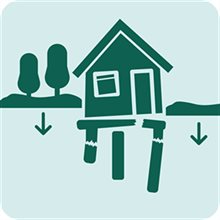
Subsidence can damage the foundations of buildings. This is a major and growing problem in the Netherlands (PDF): an estimated 425,000 buildings are expected to suffer serious foundation issues within the next 15 years, based on 2024 estimates, at a total repair cost of up to €60 billion by 2050. This damage is driven by changes in groundwater levels and soil movement, and climate change is expected to accelerate it, as more frequent and severe dry periods drive groundwater levels lower on a more regular basis. The severity of this damage depends on the amount and rate of differential displacement, which may vary across a site, and on structural factors such as the type and condition of the building and its foundation. Only the ground-related component is considered here. It can be broadly divided into two mechanisms: pile degradation and differential settlement.
Pile degradation
Buildings built on wooden pile foundations (mostly constructed before 1975) are vulnerable to pile degradation caused by fluctuating groundwater levels. Under normal conditions, these wooden piles stay submerged, which keeps oxygen away from the wood. However, when groundwater levels drop during dry periods or due to pumping, the piles become exposed to oxygen, creating a high risk of fungal infection that causes the wood to rot. Wooden piles can also degrade through bacterial decay, even while fully submerged. If this deterioration continues for long enough, it weakens the piles' load-bearing capacity so severely that the building they support begins to move.
Differential settlement
Differential settlement occurs when the ground beneath a building subsides at different rates across the site. This uneven subsidence, caused by varying subsurface composition, uneven weight distribution, or a weak foundation, can cause a building to tilt or bend rather than sink evenly. The resulting damage includes cracked walls, uneven floors, and doors or windows that stick or jam. Buildings with shallow foundations are particularly vulnerable to this kind of soil movement.
The foundation damage caused by pile degradation and differential settlement carries significant financial consequences for homeowners. Repair costs for individual buildings can exceed a hundred thousand euros per home, depending on its size, foundation type, and the severity of the damage. Since foundation damage is not insurable, there is a risk that some real estate has been overpriced in the past, particularly in areas not previously known for subsidence risk, leaving homeowners with mortgages that exceed their property's true value. Research by banks and real estate agents shows that homes with confirmed foundation damage are valued lower than comparable homes without such damage. Even in vulnerable areas where no damage has been explicitly identified, a pricing discount linked to this risk is already becoming visible.
New constructions
Land subsidence also affects new construction, requiring upfront investments not needed in areas that are not susceptible to land subsidence. These costs are typically far lower than those authorities face later if subsidence is not accounted for properly during construction.
Infrastructure
Land subsidence and vertical land movement (for example through shrinkage and swelling) can also damage roads, dikes, railways, bridges, sewers, cables, and pipelines. Differential settlement can cause cracking, as well as bumps and sagging in roads, requiring costly repairs. Beyond the risks to safety and accessibility, this creates a long-term financial burden through rising maintenance costs for public and private infrastructure. Municipalities in soft soil areas must raise infrastructure and public spaces more frequently as a result, and face more frequent damage to cables, pipes, and roads. In 2016, the Netherlands Environmental Assessment Agency (PBL) calculated (PDF) that land subsidence would cause around €6 billion in infrastructure damage by 2050.
New constructions
Land subsidence also affects new construction, requiring upfront investments not needed in areas that are not susceptible to land subsidence. These costs are typically far lower than those authorities face later if subsidence is not accounted for properly during construction.
Agriculture
In the Netherlands, the relationship between land use and land subsidence is complex. Much of the country's agriculture only became possible by draining peat and clay soils that were previously too wet to farm. This same drainage, however, accelerates subsidence. Subsidence can be slowed by keeping ditch water levels higher (limiting further drainage), but this reduces both productivity and the ground's ability to bear heavy machinery. When subsiding soft soil areas are fully inundated, land subsidence will stall; however, this means such areas become primarily suitable as nature reserves. As a result, ditch levels are typically lowered again to maintain productivity, creating a vicious circle in which drainage causes subsidence, and subsidence prompts further drainage. Breaking this cycle requires changes to farming practices or land use. Agricultural land can also be affected from the other direction: policies designed to limit subsidence may involve making areas wetter. Where this happens, current land use may no longer be viable, making a shift in land use unavoidable. Lowering water levels for agriculture can also draw water away from nearby nature areas, causing them to dry out.
Nature
Land subsidence often coincides with saline groundwater intrusion, as both can result from a decrease in groundwater pressure, for example due to water level management. When groundwater levels change and the land sinks unevenly, this affects underground water pressure and how groundwater moves. As a result, saline groundwater from deeper layers can be pushed closer to the surface, particularly in the deep polders. Saline intrusion can further reduce water quality. In addition, drained peat soils are exposed to more oxygen, which triggers chemical reactions in the soil (known as changes in redox conditions). These reactions can alter nutrient levels in the water and release metals that were previously locked in the soil. Nature areas are often affected by water management choices made elsewhere to manage land subsidence: when water levels are lowered for agriculture, water can be drawn out of adjacent nature areas, causing them to dry out. Together, these effects mean that land subsidence, together with the water management that drives it contributes to a wider loss of ecosystem services across the Netherlands.
Water management
Land subsidence in the Netherlands gradually increases flood risk. In fact, in low-lying areas with soft soils, subsidence often outpaces sea level rise itself, weakening the country's long-term starting position for dealing with future sea level rise. Subsidence also worsens the impact of flooding: water depths in affected areas increase compared to pre-subsidence levels, as does the time it takes for floodwater to drain away.
The Dutch water system is heavily regulated to manage this risk. While some drainage happens by gravity, large parts of the country depend on pumps, weirs and other hydraulic structures. This is particularly the case in the lower-lying areas, where a complex network of polders, ditches and surface waters is maintained at different levels to suit different types of land use. However, as long as water levels keep being adjusted to match land use, the soil will continue to subside, requiring further adjustments to water levels in turn. Taken together, these effects mean that more investment will be needed, both in flood protection infrastructure and in the energy and operation of the water management system. This is essential to meet established flood risk standards in subsiding and surrounding areas.