Coastal erosion
The Dutch coastline contains 300 kilometres of sandy beaches and dunes, which are constantly changing under the influence of natural forces such as waves, tidal currents and wind. In some places, the coastline loses more sand than it gains. This process is called coastal erosion and leads to the coastline and dunes slowly moving inland. In years with many storms, this process happens faster.
Without action, erosion will make beaches and dunes narrower over time. This affects several important coastal functions. Dunes protect the country from flooding, store fresh water for drinking water supplies, provide space for nature reserves and support tourism. Therefore, the Netherlands regularly adds sand along the coast to mitigate erosion. Hard measures are only applied when soft measures are not sufficient.
What is a sand nourishment?
Sand on the beach can be replenished with sand nourishments. These are measures that add extra sand to the beach or seabed just off the coast. The sand is collected by special dredging vessels from the seabed at more than 20 metres depth, far enough away to not affect the existing beaches in the long term. Dutch regulations set aside large areas of the North Sea seabed specifically for collecting this sand.
Wind, waves and currents gradually spread the sand along the coastline and into the dunes. This makes sand nourishments a very adaptive measure, because they do not only mitigate erosion, but also allow the coastline to keep up with sea level rise.
A distinction can be made between three types of nourishments:
- Beach nourishments
Sand is pumped directly onto the beach. This effectively restores the coastline at places where erosion is strongest. Sometimes sand is also placed in the dunes to restore their protective function. Beach nourishments are used in places where a direct and local effect is needed. - Shoreface nourishments
Sand is placed on the shallow seabed just off the coast at a depth of 4 to 8 metres. From there, waves and currents slowly move the sand towards the coast over time. These shoreface nourishments reduce long-term erosion pressures, but do not directly affect local beach erosion. They are mainly used to protect the coastline over a longer period in a cost-effective way. A special use of shoreface nourishments is to stabilise the edges of tidal channels, preventing them from moving further inland. - System nourishments
Larger volumes of sand are placed on the beach to cover dykes with natural landscapes or to create new land. These system nourishments do not only improve coastal safety locally, but also benefit nature, recreation and drinking water supplies. The sand also spreads to the surrounding coastal areas over many years, providing benefits at a regional scale. Well-known examples include the Sand Motor, Hondsbossche Duinen and Prins-Hendrik Zanddijk.
Innovation in system nourishments: The Sand Motor
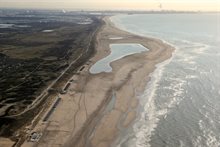
The Sand Motor is an innovative coastal maintenance measure that uses the forces of nature to spread sand to the places where it is needed. In 2011, this large-scale sand nourishment pilot was carried out at the coast of Delfland, just South of The Hague. It consists of an artificial peninsula of 21.5 million cubic metres of sand, extending 2.5 kilometres along the coast and 1 kilometres into the sea. Wind, waves and currents gradually spread the sand along the coastline and towards the dunes.
This single system nourishment replaced the need for repeated smaller ones, making it more cost-effective and more nature-friendly. After ten years, the pilot was evaluated as a success (PDF): the coastline broadened and the dunes grew. The Sand Motor also created new opportunities for recreation and improved the diversity of the natural habitats, making it a multifunctional area. The knowledge gained from this project allows coastal managers to better plan and design future sand nourishments in the Netherlands.
Drivers for coastal erosion
The main driver for coastal erosion in the Netherlands is the movement of sand by waves that approach the coast at an angle. These waves mostly come from the south-west, and to a lesser extent from the north and northwest. They pick up sand at certain parts of the coast, such as the tips of the Wadden islands and the southern end of the Holland coast and transport it to the north-east. This causes some areas to lose sand structurally over time.
Storms make erosion more visible: they move sand from the dry beach and dunes to the underwater part of the coast. However, in a healthy coastal system, this sand is not lost. Waves and wind gradually bring it back to the beach and dunes over time. Storms therefore do not necessarily cause more erosion than the slow but persistent effect of everyday wave conditions.
Other drivers, such as tidal and wind-driven currents, also play a role in coastal erosion but contribute less than waves. Research at the Sand Motor showed, for example, that tides played only a small role in erosion, while waves were the dominant factor. Near tidal inlets, such as the tips of the Wadden Islands, tides can however cause significant local erosion.